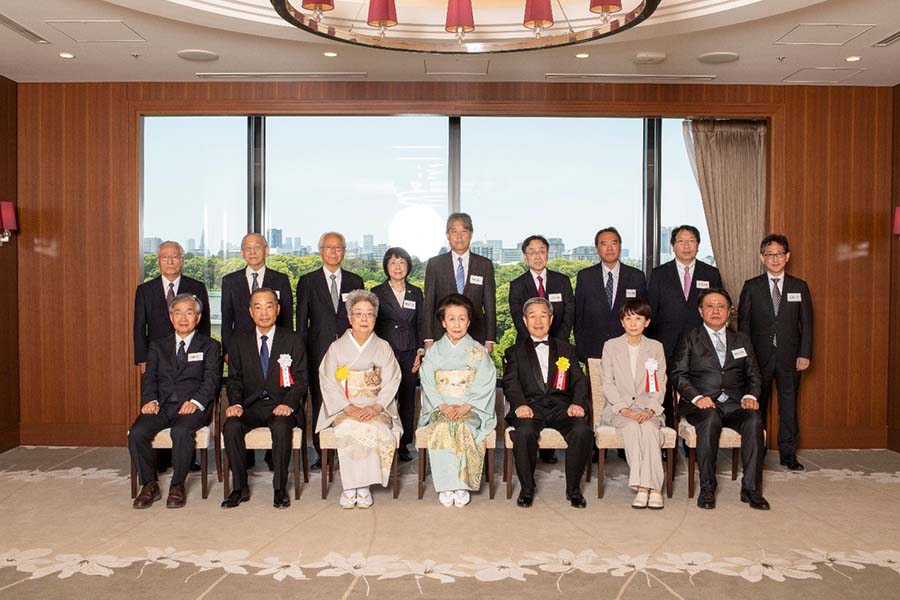

2026年比較腫瘍学常陸宮賞受賞者
The Awardee of the 2026 Prince Hitachi Prize for Comparative Oncology
Avian retroviral oncogene erbB and intracellular signaling
トリ腫瘍ウイルスがん遺伝子erbBと細胞内シグナルの研究
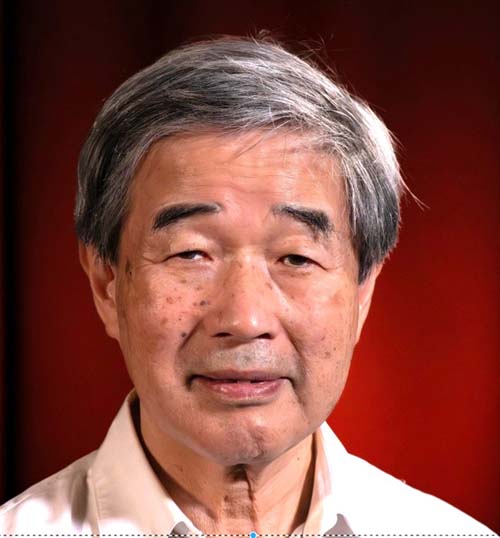
Tadashi Yamamoto
Professor,
Cell Signal Unit Okinawa Institute of Science and Technology Graduate University
山本 雅 博士
沖縄科学技術大学院大学細胞シグナルユニット 教授
略歴
山本雅博士は、1947年に福井県大野郡で生まれ、1966年大阪大学理学部生物学科に入学した。その後同大学大学院理学研究科に進学し1977年3月に博士号を取得した。大学院では大阪大学微生物病研究所の松代愛三教授ならびに今本文男助教授のもとで大腸菌trp mRNA の分解機構に関する研究を行った。大学院修了後の1977年9月より米国NIH癌研究所のIra Pastan博士の研究室に留学し、ニワトリ肉腫ウイルスによる細胞癌化ならびにウイルス複製に関する研究を行った。この時にRNA腫瘍ウイルスに特有のLTR配列を分子クローニングし、ウイルスゲノムの複製機構の理解に貢献するとともに、LTRが強力な転写プロモーター活性を有することを実証した。これをきっかけに外来遺伝子発現ベクターに広く腫瘍ウイルスLTRが用いられることとなった。NIHでの研究が東京大学医科学研究所の豊島久真男教授に認められ、1980年9月に同医科学研究所制癌研究部に助手として着任した。着任後新種トリ赤芽球症ウイルスAEV-Hによる発がん研究を進めがん化責任遺伝子がv-erbBであることを明らかにした。v-erbB塩基配列から推定したアミノ酸配列がEGF受容体のアミノ酸配列と酷似していることがわかり、ウイルスのv-erbBが細胞のEGF受容体遺伝子に由来する事が強く示唆された。さらに山本はトリウイルスのがん遺伝子v-srcや v-yesそしてネコウイルスがん遺伝子v-fgrの細胞ホモログとしてfynとlynを見出した。山本は1986年4月に東京大学医科学研究所助教授に、さらに1991年11月に同教授に昇任し、自らのがんシグナル研究室を主宰した。そこでは大学院生らとともにv-erbBと酷似するc-erbB-2遺伝子に関するがん研究ならびにfynとlynに関する細胞内シグナル研究を展開した。東京大学医科学研究所所長(2003〜2007年)、日本学術会議会員(2006〜2011年)、東京大学北京研究センター長(2012〜2014年)、理研統合生命医科学センター長 (2015〜2020年)、日本分子生物学会年会長(2009年)、米国General Motor学術賞選考委員(2009〜2012年)、日本科学技術振興機構CREST研究総括(2012〜2020年)などを歴任。NIH Fogarty Scholar (2007〜2009年)、日本癌学会奨励賞(1984年)、高松宮妃癌研究基金学術賞(1987年)、朝日賞(1990年)、日本癌学会吉田富三賞(2014年)等を受賞。
Personal History Outline
Tadashi Yamamoto was born in 1947 in Ono-gun, Fukui Prefecture. He entered the Faculty of Science, Osaka University in 1966. He subsequently advanced to the Graduate School of Science at the same university and received his doctorate in March 1977. In the graduate school he studied the mechanism of E. coli mRNA decay under supervision of Professor Aizo Matsushiro and Associate Professor Fumio Imamoto. On September 1977 he moved to the laboratory of Dr. Ira Pastan at the NIH/NCI, where he studied cellular transformation by avian sarcoma virus and the mechanism of viral replication. He molecularly cloned the long terminal repeat (LTR) sequence characteristic of RNA tumor viruses, contributing to understanding viral genome replication mechanisms and demonstrating that the LTR possesses strong transcriptional promoter activity. This finding led to widespread use of tumor-virus LTRs in foreign-gene expression vectors. Yamamoto’s work at the NIH was recognized by Professor Kumao Toyoshima of the Institute of Medical Science, University of Tokyo. In September 1980 he joined the Institute’s Department of Oncology as an assistant professor. After his appointment he pursued oncogenesis research with a new strain of avian erythroblastosis virus, AEV-H, and identified and reported that the gene responsible for cell transformation was v-erbB. The amino acid sequence predicted from the v‑erbB nucleotide sequence was found to closely resemble that of the EGF receptor, strongly arguing that viral v‑erbB derived from the cellular EGF receptor gene. He also identified c-erbB-2 gene as another v-erbB-related gene, as well as fyn and lyn as the cellular homologs of the avian- and feline- sarcoma viral oncogenes. Yamamoto was promoted to Associate Professor at the Institute of Medical Science, The University of Tokyo in April 1986, and further to Professor in November 1991, where he headed his own laboratory. He served as Director of the Institute of Medical Science, The University of Tokyo (2003–2007), a member of the Science Council of Japan (2006–2011), Director of the University of Tokyo Beijing Research Center (2012–2014), Director of RIKEN Center for Integrative Medical Sciences (2015-2020), President of the Japanese Society for Molecular Biology annual meeting (2009), member of the selection committee for the U.S. General Motors Foundation Science Awards (2009–2012), and Research Director for JST-CREST (2012–2020). He was an NIH Fogarty Scholar (2007–2009) and has received awards, including Incentive Award from the Japanese Cancer Association (1984), Princess Takamatsu Cancer Research Fund Prize. (1987), the Asahi Prize (1990), and the Tomizo Yoshida Award from the Japanese Cancer Association (2014).
受賞対象となった研究業績
トリ腫瘍ウイルスがん遺伝子erbBと細胞内シグナルに関する研究
山本雅博士は1966年に大阪大学に入学し、同大学大学院で生理学を専攻して分子生物学を学んだ。博士号取得後、1977年から1981年まで米国国立がん研究所のIra Pastan博士の下に留学し、トリRNA腫瘍ウイルスによる発がんメカニズムを探る研究を開始した。その過程でRNA腫瘍ウイルス特有のLTR(long terminal repeat)配列をクローニングし、その強い転写プロモーター活性を世界に先駆けて見出した(Cell, 1980)。この発見を契機に、外来遺伝子発現ベクターにLTRが広く用いられるようになった。
1980年、山本博士は東京大学医科学研究所の文部教官助手に採用され、豊島久真男教授の下で研究を始めた。我が国で日原宏らにより新たに単離されたトリ赤芽球症ウイルスAEV-Hの分子腫瘍学的研究を推進し、赤芽球症の原因遺伝子がv-erbBであることを明らかにした(Cell, 1983a)。山本博士らのv-erbB配列解析(Cell, 1983b)とUniversity College LondonのWaterfield博士らによるEGF受容体配列解析により、v-erbBが細胞のEGF受容体遺伝子に由来することが明らかになった。以降、EGF受容体遺伝子はc-erbB/EGFRと呼ばれるようになった。この知見は「宿主遺伝子が宿主のがん発症に関与する」という概念の確立に大きく貢献した。実際に山本博士らはがん細胞株やがん組織検体を調べ、ヒト扁平上皮がんでしばしばc-erbB/EGFRが遺伝子増幅および過剰発現していることを見出した。
その後、山本博士は大学院生らとともに、c-erbB/EGFRに類似する新規遺伝子c-erbB-2を同定した。c-erbB-2タンパク(ERBB2)は増殖因子受容体であると考えられたが、リガンドが容易に見つからなかった。そのなかで進められた山本博士らや他の研究者らによる構造生物学的・生化学的研究から、ERBB2がリガンド結合なしに強力なシグナル伝達能を有する受容体型チロシンキナーゼであることが明らかになった。山本博士らはc-erbB-2がヒト腺がん、特に悪性度の高い乳がんで頻繁に増幅・過剰発現することを示し、その臨床的重要性を指摘した。また、MITのWeinberg博士らが報告したラット神経膠芽腫遺伝子neuがc-erbB-2のオルソログであることが判明し、Weinberg博士らと山本博士らの論文が同時公表された(Nature, 1986)。ほぼ同時期にGenentechのUllrich博士らがEGF受容体に類似する遺伝子としてヒトHER2を報告した。以後c-erbB-2/HER2研究は乳がんの診断・治療薬開発へと発展した。山本博士は東北大学益子高博士や株式会社ニチレイ等と共同で抗ERBB2抗体を作製し、乳がん診断用抗体キットの開発に関わった。Ullrich博士らによる抗HER2抗体医薬(トラスツズマブ)の開発と相まって、ERBB2/HER2陽性乳がんに対する有効な診断法および分子標的療法が生まれた。同時期に山本博士らは、トリやネコのRNA腫瘍ウイルスが持つがん遺伝子yesやfgrの細胞ホモログとしてfynやlynを発見した。FYN、LYNチロシンキナーゼは中枢神経系や免疫系で高く発現することや、抗原受容体などの細胞表面タンパク質と会合して細胞の分化や機能を制御することを次々に明らかにした(Science, 1991; Nature, 1994)。これらの山本博士らのチロシンキナーゼをツールとした細胞内シグナル伝達研究は、西塚泰美博士のPKC研究を端緒とする細胞内シグナル伝達の概念確立に貢献した。
1996年、山本博士らはERBB2シグナル研究からTOB(Target Of ERBB2)下流エフェクターを同定した。具体的には、TOBはERBB2などの受容体型チロシンキナーゼ下流のMAPキナーゼによってリン酸化され、機能が変換される。TOBはÉcole normale supérieure de LyonのRouault博士らが報告していた抗増殖性因子BTG1と相同性を持っていた。山本博士らはTOB遺伝子欠損マウスが骨の過形成を示すことや、老齢後にがん発症率が高まることを示した(Cell, 2000など)。さらに、TOBがCCR4–NOTデアデニラーゼ複合体と会合することを明らかにした。CCR4–NOT複合体は転写からmRNA翻訳・分解に至る転写後制御の中枢で機能しており、山本博士らはCCR4–NOT複合体研究を通じてインスリン代謝や免疫細胞分化、肥満制御に関する知見を得た(Cell Report, 2015など)。
このように、ニワトリウイルス性発がん遺伝子v-erbBの同定からc-erbB/EGFRおよびc-erbB-2の機能解析に至る山本博士の研究は、基礎的な分子ウイルス学から臨床応用への明確な道筋を示している。発がん遺伝子生物学の基本原理を確立し、ERBB2/HER2陽性がんの診断ツールや分子標的治療の開発に寄与した。近年山本博士らは、シグナル分子TOBが抗がん剤による細胞死に抵抗する活性を持つことを示し、TOBsiRNAを用いたがん治療の開発を進めている。
Academic Achievement Related to this Award
Avian retroviral oncogene erbB and intracellular signaling
Dr. Tadashi Yamamoto entered Osaka University in 1966 and studied physiology and molecular biology. He studied from 1977 to 1981 under Dr. Ira Pastan at the U.S. National Cancer Institute, where his research brought him into contact with avian RNA tumor viruses. Using avian sarcoma virus-transformed cells, he sought the mechanism underlying cell transformation. In that process, he cloned the virus-specific LTR (long terminal repeat) sequence and was the first to demonstrate its strong transcriptional promoter activity. This discovery led to widespread use of LTRs in foreign-gene expression vectors.
In 1980, Dr. Yamamoto was appointed as an Assistant Professor at the Institute of Medical Science, the University of Tokyo, and began his research under Professor Kumao Toyoshima. He molecularly and oncologically studied the avian erythroblastosis virus AEV-H, newly isolated by Dr. Hiroshi Hihara, and reported that v-erbB is causative to erythroblastosis. Sequence analysis of v-erbB by Dr. Yamamoto together with sequence analysis of EGF receptor by Dr. Michael Waterfield at University College London, revealed that v-erbB is derived from the cellular EGF receptor gene. Since then, the EGF receptor gene has been referred to as c-erbB/EGFR. This finding greatly contributed to the formation of the concept that host genes can play critical roles in tumorigenesis. Indeed, by examining cancer cell lines and tumor specimens, Dr. Yamamoto and colleagues found that c-erbB is frequently gene-amplified and overexpressed in human squamous-cell carcinomas.
Dr. Yamamoto identified a novel gene, c-erbB-2, closely related to c-erbB/EGFR. Although the c-erbB-2 protein (ERBB2) was suspected to be a growth factor receptor and its ligand was not found, structural and biochemical studies by his group and others showed that ERBB2 is a receptor-type tyrosine kinase with strong signaling activity even in the absence of ligand. His group also demonstrated that c-erbB-2 is frequently amplified and overexpressed in human adenocarcinomas, particularly in highly malignant breast cancers, highlighting its clinical significance. The rat glioblastoma gene neu, identified by Dr. Robert Weinberg, was soon recognized as an ortholog of c-erbB-2 and around the same time, Dr. Axel Ullrich at Genentech reported the human HER2 gene, similar to the EGF receptor gene. Subsequent c-erbB-2/HER2 research has advanced into the development of diagnostic and therapeutic drugs for breast cancer. Dr. Yamamoto collaborated with Dr. Takashi Masuko of Tohoku University and Nichirei Corporation to develop anti-ERBB2 antibodies and participated in the development of diagnostic antibody kits for cancer. Together with Ullrich’s development of the anti-HER2 therapeutic antibody trastuzumab, diagnostics and molecular targeted therapies for ERBB2/HER2-positive breast cancer emerged.
Around the same time, Dr. Yamamoto also discovered the cellular homologs of viral oncogenes, src, yes, and fgr, from avian and feline RNA tumor viruses and named them fyn and lyn; these genes encode tyrosine kinases. Dr. Yamamoto showed FYN and LYN are well expressed in the central nervous system and immune system and associate with cell-surface proteins such as antigen receptors to regulate cellular differentiation and function. Studies using these tyrosine kinases as tools advanced intracellular signaling research and contributed greatly to phosphorylation-signal research and to establishment of intracellular signaling concepts initiated by Dr. Yasutomi Nishizuka’s PKC studies.
In 1996, Dr. Yamamoto identified TOB (Target Of ERBB2) as an effector downstream of ERBB2. TOB shares homology with the antiproliferative gene BTG1 reported by Dr. Jean-Pierre Rouault at the École normale supérieure de Lyon, suggesting a role in cell proliferation control. Indeed Dr. Yamamoto found that TOB-deficient mice exhibit bone overgrowth and an increased incidence of cancer with age. His group also showed that TOB associates with the CCR4–NOT deadenylase complex, central to post-transcriptional regulation. Through CCR4–NOT research Dr. Yamamoto gained insights into insulin metabolism, obesity, and immune-cell differentiation.
In summary, Yamamoto’s research, beginning with avian viruses, traces a clear trajectory from basic molecular virology to clinical application. In recent years, he has been developing a TOB siRNA-based novel cancer therapy.
Bibliography (Selected):
- Yamamoto T, de Crombrugghe B, Pastan I: Identification of a functional promoter in the long terminal repeat of Rous sarcoma virus. Cell 22, 787-797 (1980)
- Yamamoto T, Kawai S, Koyama T, Hihara H, Shimizu T, Toyoshima K: Newly generated avian erythroblastosis virus produces noninfectious particles lacking env-gene products. Virology 129: 31-39 (1983)
- Yamamoto T, Hihara H, Nishida T, Kawai S, Toyoshima K: A new avian erythroblastosis virus, AEV-H, carries erbB gene responsible for the induction of both erythroblastosis and sarcomas. Cell 34, 225-232 (1983)
- Yamamoto T, Nishida T, Miyajima N, Kawai S, Ooi T, Toyoshima K: The erbB gene of avian erythroblastosis virus is a member of the src gene family. Cell 35, 71-78 (1983)
- Merlino GT, Xu YH, Ishii S, Clark AJ, Semba K, Toyoshima K, Yamamoto T, Pastan I: Amplification and enhanced expression of the epidermal growth factor receptor gene in A431 human carcinoma cells. Science 224, 417-419 (1984)
- Semba K, Kamata N, Toyoshima K, Yamamoto T: A v-erbB- related protooncogene, c-erbB-2, is distinct from the c-erbB-1/epidermal growth factor receptor gene and is amplified in a human salivary gland adenocarcinoma. Proc. Natl. Acad. Sci. USA 82, 6497-6501 (1985)
- Yamamoto T, Kamata N, Kawano H, Shimizu S, Kuroki T, Toyoshima K, Rikimaru K, Nomura N, Ishizaki R, Pastan I, Gamou S, Shimizu N: High incidence of amplification of the epidermal growth factor receptor gene in human squamous carcinoma cell lines. Cancer Res. 46, 414-416 (1986)
- Yamamoto T, Ikawa S, Akiyama T, Semba K, Nomura N, Miyajima N, Saito T, Toyoshima K: Similarity of protein encoded by the human c-erb-B-2 gene to epidermal growth factor receptor. Nature 319, 230-234 (1986)
- Fukushige S, Matsubara K, Yoshida M, Sasaki M, Suzuki T, Semba K, Toyoshima K, Yamamoto T: Localization of a novel v-erbB-related gene, c-erbB-2, on the human chromosome 17 and its amplification in a gastric cancer cell line. Mol. Cell. Biol. 6, 955-958 (1986)
- Akiyama T, Sudo C, Ogawara H, Toyoshima K, Yamamoto T: The product of the human c-erbB-2 gene ; a 185-kilodalton glycoprotein with tyrosine kinase activity. Science 232, 1644-1646 (1986)
- Ishii S, Imamoto F, Yamanashi Y, Toyoshima K, Yamamoto T: Characterization of the promoter region of the human c-erbB-2 protooncogene. Proc. Natl. Acad. Sci. USA 84, 4347-4378 (1987)
- Akiyama T, Saito T, Ogawara H, Toyoshima K, Yamamoto T: Tumor promoter and epidermal growth factor stimulate phosphorylation of the c-erbB-2 gene product in MKN-7 human adenocarcinoma cells. Mol. Cell. Biol. 8, 1019-1026 (1988)
- Yamanashi Y, Mori S, Yoshida M, Kishimoto T, Inoue K, Yamamoto T, Toyoshima K: Selective expression of a protein-tyrosine kinase, p56lyn, in hematopoietic cells and association with production of human T-cell lymphotropic virus type I. Proc. Natl. Acad. Sci. USA 86, 6538-6542 (1989)
- Katagiri T, Urakawa K, Yamanashi Y, Semba K, Takahashi T, Toyoshima K, Yamamoto T, Kano K: Overexpression of src family gene for tyrosine-kinase p59fyn in CD4-CD8-T cells of mice with a lymphoproliferative disorder. Proc.Natl. Acad. Sci. USA 86, 10064-10068 (1989)
- Suda Y, Aizawa S, Furuta Y, Yagi T, Ikawa Y, Saitoh K, Yamada Y, Toyoshima K, Yamamoto T: Induction of a variety of tumors by c-erbB2 and clonal nature of lymphomas even with the mutated gene (Val659 → Glu659). EMBO J. 9, 181-190 (1990)
- Yamanashi Y, Kakiuchi T, Mizuguchi J, Yamamoto T, Toyoshima K: Association of B cell antigen receptor with protein tyrosine kinase Lyn. Science 251, 192-194 (1991)
- Akiyama T, Matsuda S, Namba Y, Saito T, Toyoshima K, Yamamoto T: The transforming potential of the c-erbB-2 protein is regulated by its autophosphorylation at the carboxyl-terminal domain. Mol. Cell. Biol. 11, 833-842 (1991)
- Yamanashi Y, Fukui Y, Wongsasant B, Kinoshita Y, Ichimori Y, Toyoshima K, Yamamoto T: Activation of Src-like protein-tyrosine kinase Lyn and its association with phosphatidylinositol 3- kinase upon B-cell antigen receptor-mediated signaling. Proc. Natl. Acad. Sci. USA 89, 1118-1122 (1992)
- Umemori H, Sato S, Yagi T, Aizawa S, Yamamoto T: Initial events of myelination involve Fyn tyrosine kinase signalling. Nature 367, 572-576 (1994)
- Nishizumi H, Taniuchi I, Yamanashi Y, Kitamura D, Ilic D, Mori S, Watanabe T, Yamamoto T: Impaired proliferation of peripheral B cells and indication of autoimmune disease in lyn-deficient mice. Immunity 3, 549-560 (1995)
- Yoshida Y, Tanaka S, Umemori H, Minowa O, Usui M, Ikematsu N, Hosoda E, Imamura T, Kuno J, Yamashita T, Miyazono K, Noda M, Noda T, Yamamoto T: Negative regulation of BMP/Smad signaling by Tob in osteoblasts. Cell 103, 1085-1097 (2000)
- Takahashi A, Adachi S, Morita M, Tokumasu M, Natsume T, Suzuki T, Yamamoto T: Post-transcriptional stabilization of ucp1 mRNA protects mice from diet-Induced obesity. Cell Rep 13, 2756-2767 (2015)
- Ito-Kureha T, Miyao T, Nishijima S, Suzuki T, Koizumi S-I, Villar-Briones A, Takahashi A, Akiyama N, Morita M, Naguro I, Ishikawa H, Ichijo H, Akiyama T, Yamamoto T. The CCR4-NOT deadenylase complex safeguards thymic positive selection by down-regulating aberrant pro-apoptotic gene expression. Nature Commun 11(1), 6169- (2020)